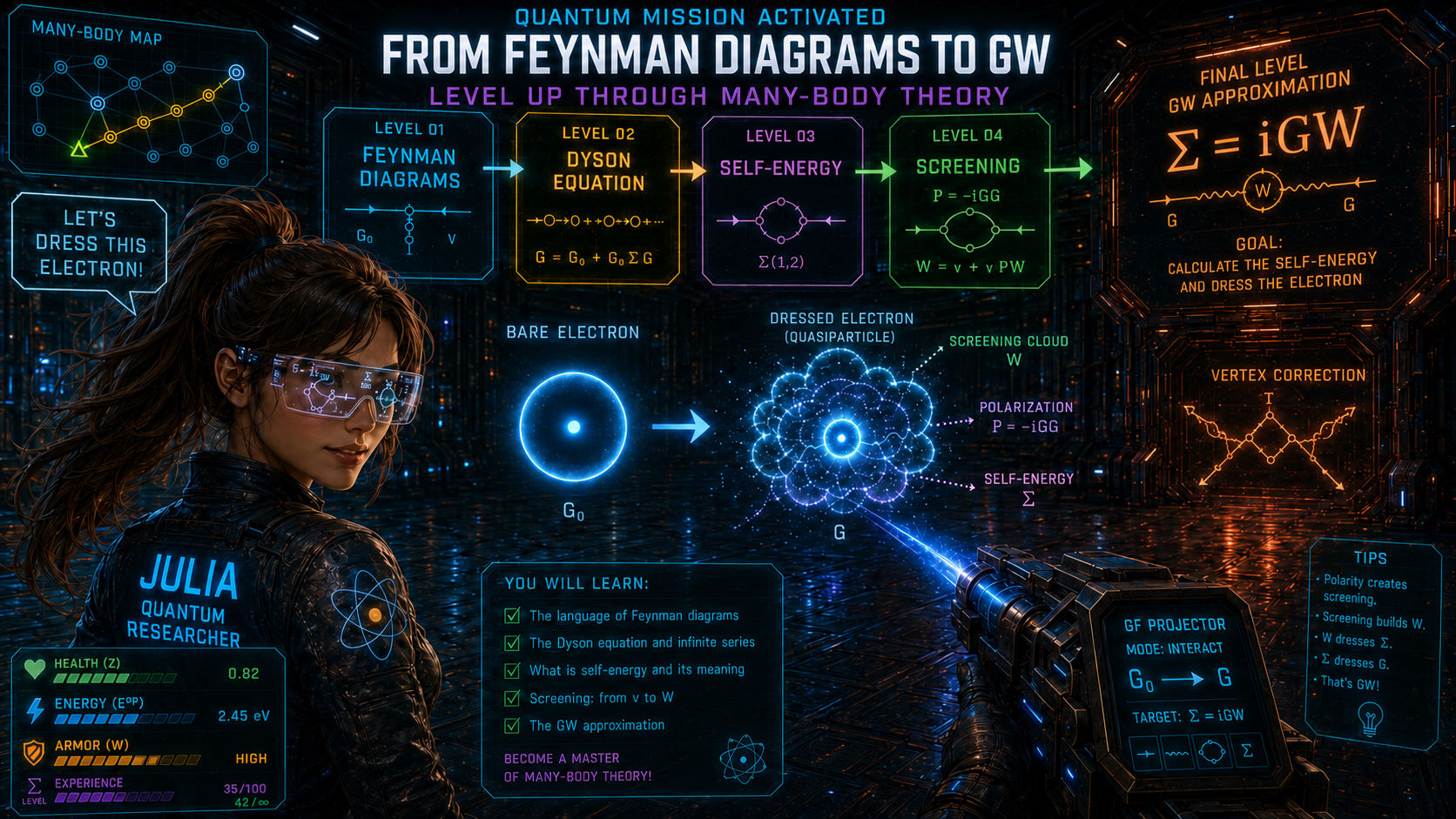
Feynman diagrams were originally developed in quantum electrodynamics as a graphical language for representing the interactions of elementary particles. Over time, the same diagrammatic ideas became fundamental to many-body theory and are now widely used in condensed matter physics, quantum chemistry, nuclear physics, and computational materials science.
The new Delta Science Institute tutorial, Feynman Diagrams and the GW Approximation, introduces this graphical language from the perspective of electronic systems in materials.
The purpose of the tutorial is not simply to show familiar diagrammatic symbols, but to explain how a diagram can be translated into a corresponding many-body equation—and how an equation can be reconstructed as a diagram.
The tutorial begins with the basic elements of diagrammatic notation, including bare and interacting Green’s functions, interaction lines, vertices, internal variables, and fermionic arrows. Particular attention is given to conventions commonly used in condensed matter physics, where diagrammatic notation may differ from the conventions encountered in high-energy physics.
The discussion then develops the connection between Feynman diagrams and several central concepts of many-body perturbation theory:
- the Dyson equation;
- the electron self-energy;
- polarization processes;
- screening of the Coulomb interaction;
- the distinction between bare and dressed propagation;
- repeated self-energy insertions;
- the GW approximation.
The GW approximation provides a particularly clear example of how several diagrammatic objects work together. The self-energy is expressed in terms of the interacting Green’s function and the screened Coulomb interaction, while screening is generated through polarization processes. The tutorial shows how these coupled equations can be represented graphically and how the corresponding diagrams help reveal their physical meaning.
Special emphasis is placed on the interpretation of the diagrams. Rather than treating the GW method as a formal computational procedure or a black box, the tutorial explains the physical processes represented by each line and vertex: electron propagation, interaction with the surrounding electronic environment, polarization of the system, and dynamical screening.
The tutorial is intended for graduate students, early-career researchers, and anyone beginning to work with many-body Green’s-function methods. It may be especially useful for readers in:
- condensed matter physics;
- computational materials science;
- quantum chemistry;
- electronic-structure theory;
- many-body perturbation theory;
- GW and Bethe–Salpeter calculations.
It can also serve as a bridge between introductory quantum mechanics, density functional theory, and more advanced many-body approaches.
The material is organized as a visual and conceptual introduction, with separate sections devoted to Feynman diagrams, the Dyson equation, self-energy, and the GW approximation. More advanced discussions are included for readers who want to examine operator identities, perturbative expansions, proper and improper diagrams, skeleton diagrams, and the structure of the coupled GW equations in greater detail.
Begin the quest: explore the tutorial and learn to translate between many-body equations and their graphical language: