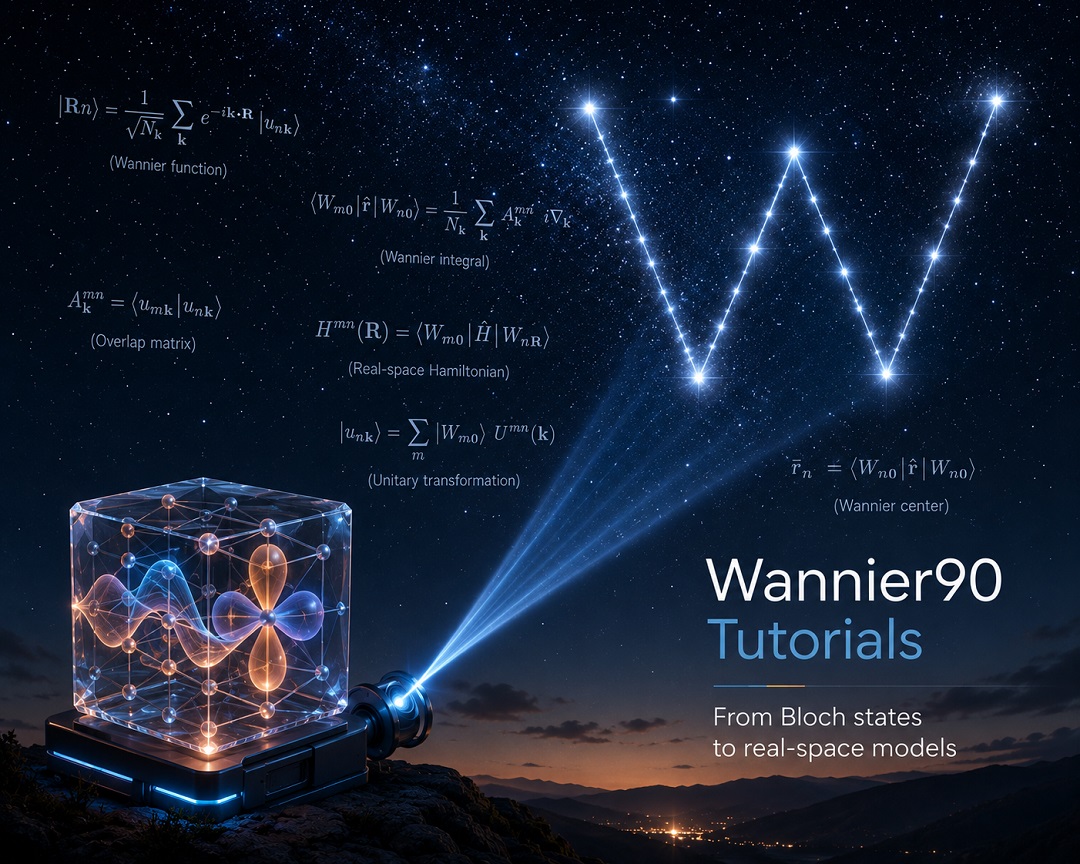
Wannier functions have become an essential tool in modern computational materials science, providing a connection between first-principles electronic-structure calculations and compact models used for band interpolation, transport, topology, excitons, optical properties, and many other applications.
However, getting started with Wannier90 can be challenging. Even after reading the theory and documentation, many practical questions appear when building a first real Wannier model: Which projections should be chosen? How should the energy windows be selected? How can the quality of the resulting model be checked? And what should be done when the calculation does not work as expected?
To help students and researchers overcome these difficulties, Delta Science Institute has published a new step-by-step Wannier90 Tutorial.
The tutorial begins with the basic ideas behind Wannier functions and explains what Wannier90 can do and why Wannier-based models are so useful. It then guides the reader through two practical examples, with each stage of the workflow explained in sequence.
Particular attention is given not only to what commands should be run, but also to why each step is necessary, what the important output files contain, how to validate the resulting Wannier model, and how to diagnose common problems.
The tutorial also introduces the broader ecosystem of computational programs and applications that use Hamiltonians generated with Wannier90 and concludes with recommendations for further study, model improvement, and more advanced calculations.
The main goal is simple: to help students and researchers go from the basic concepts to their first working Wannier model — and understand where to go next.
🔭 Follow the W.
Explore the tutorial:
https://www.dsedu.org/tutorials/wannier90