The Introduction to Density Functional Theory course at Delta Science Institute is expanding with a new Julia programming track.
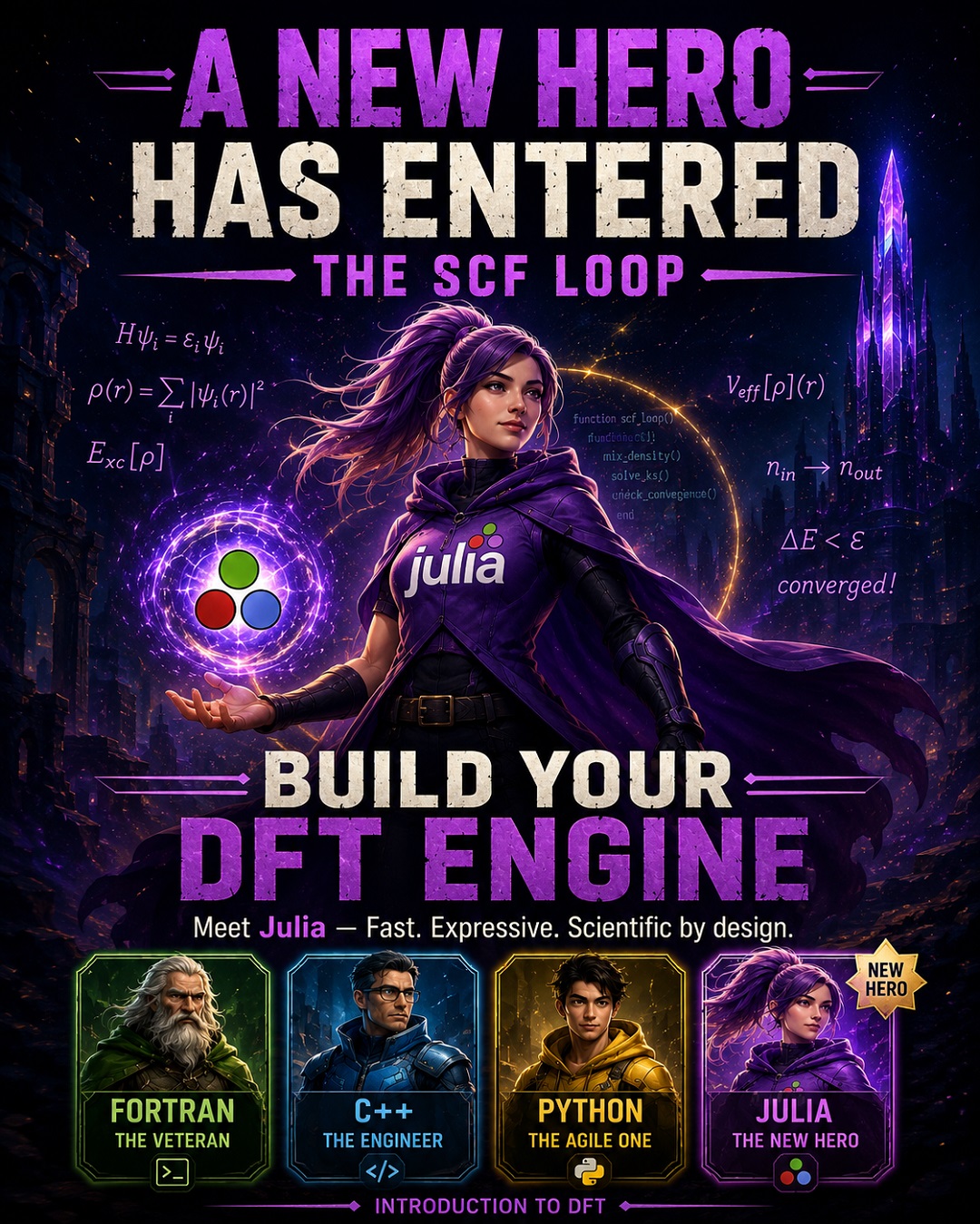
Julia is a modern programming language designed for scientific and numerical computing. Its expressive syntax and focus on high-performance computation make it particularly interesting for students and researchers working in computational physics, materials science, and electronic-structure theory.
With the addition of Julia, the course now offers implementations in four programming languages:
Fortran | C++ | Python | Julia
The goal is not to create four different versions of DFT. The physics, equations, and computational workflow remain the same. Students can study the same numerical ideas and DFT modules through different programming approaches.
This creates a particularly useful opportunity for students who already know one of the available languages. For example, a student familiar with Python can compare the Python and Julia implementations of the same DFT modules step by step: density construction, effective potentials, Hamiltonian assembly, eigensolvers, and the self-consistent field loop.
Instead of learning a new language only through isolated syntax exercises, students can explore Julia while working with a meaningful scientific problem.
The course uses a transparent toy-model DFT code designed to expose the internal structure of a self-consistent electronic-structure calculation. Students can study individual components, understand how they interact, debug the implementation, test convergence, and ultimately build and validate a complete SCF workflow.
The new Julia track supports the broader philosophy of the course:
Learn the physics. Understand the algorithm. Compare the code. Build your own DFT engine.
For students interested in computational materials science, scientific programming, or modern approaches to high-performance computing, Julia provides a new path through the course and a practical way to learn a programming language in the context of real computational physics.
Explore the course and choose your programming track.